
Experience required
Or: Do Atheists Dream of Conscious Trees?

Note: I’m covering only the most salient point from my recent article — there are others that I also think are important! I would encourage you to read the article in full, though some will be followed up in future papers.
My advisor and I just published a commentary on Disbelief, a recent book by Dr. Will Gervais. It is open-access (as all articles should be); you can read it here.
The book tries to explain why most humans believe in supernatural entities. Given that there is no apparent evidence for these entities, and given that our brains have evolved to make accurate inferences about what’s going on around us, this consistent inaccuracy is an important puzzle.
More adroitly, though, Gervais considers the modern phenomenon of atheism: many Westerners don’t seem to believe in those entities. This is another worthy puzzle, considering how common such beliefs are across all human cultures — what has happened in the West to trigger this shift?
Gervais impressively synthesizes several decades of research on the psychology of religious belief to develop his account. If you want a great survey of how scientists think about religion, I recommend reading the book!
However, our commentary is (respectfully) critical of this emerging consensus on the nature of religious beliefs. There are several reasons why, but I want to highlight one in particular. To understand the origins of supernatural belief, you need to consider the role of supernatural experience.1
i’m not religious BUT . . .
A central tenet of Disbelief, and the literature it pulls from, is that people adopt religious beliefs because they’re surrounded by other people who hold those beliefs. If you grow up with Christian parents, go to church, join Bible study groups and so forth, you end up believing in an all-powerful God. If you don’t do those things, you are unlikely to hold those beliefs.2
Okay — that all sounds reasonable. But the implication here is that people who grow up outside these communities or leave them entirely will usually become atheists. Without social influence, people are unlikely to hold religious beliefs. The supernatural is never a solitary affair.
This seems to be true for beliefs like the following: There is an all-powerful God who controls the fate of the universe.
But there are other kinds of supernatural beliefs that are less often discussed in the cognitive science of religion. For instance: The soul persists after death. Or: Plants, rocks and rivers are conscious. Do those also depend on social influence?
Apparently not. Here’s a figure we included in the commentary. It tracks rates of supernatural belief and practice across people who describe themselves, respectively, as ‘spiritual-but-not-religious’ (aka SBNR, in blue) ‘religious’ (in red), or ‘neither spiritual nor religious’ (in yellow).3
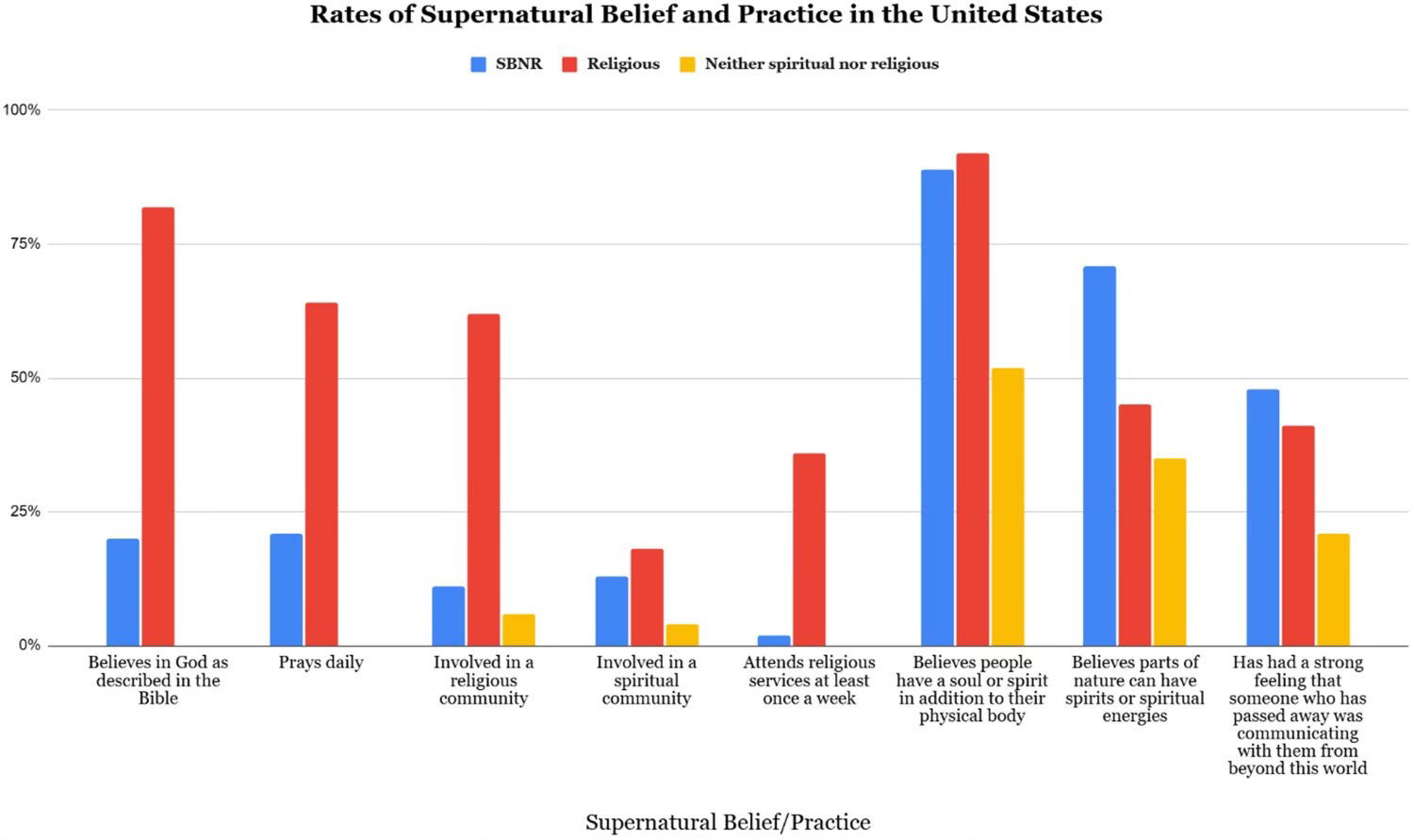
For three supernatural beliefs, SBNRs match or exceed religious people in their rates of endorsement. Yet SBNRS rarely believe in a Biblical god, pray, or involve themselves in either religious or spiritual communities.
What does this tell us? Well, it suggests that some supernatural beliefs are disconnected from social influence. For reasons other than peer pressure, people often believe in souls, spirits, and ancestor communication.
I heard all things in the heaven and in the earth
Why might that be? One strong possibility, I think, is that human minds — regardless of religious affiliation — are really prone to having supernatural experiences. By supernatural experiences, I mean experiences that seem to provide sensory evidence toward the existence of disembodied entities: for instance, auditory hallucinations or sleep paralysis.
More survey data is needed to get a firm sense of just how ubiquitous these experiences are, especially among SBNRs and so-called atheists. But there are some suggestive recent results from a survey by Ronald Fischer and colleagues. The figure below shows results from a massive survey of Brazilians, in which respondents indicated whether they’d experienced things like deja vu, hallucinatory voices and faces, a sudden sense of meaning, and so forth.4
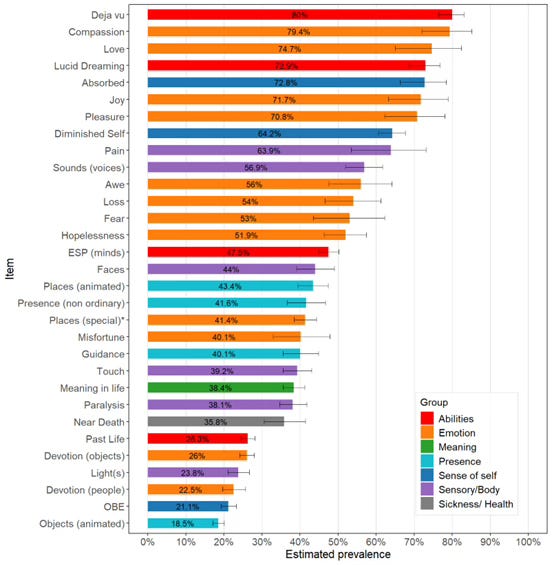
Just to toss out a few numbers: 44% of respondents said they had seen a hallucinatory face. 80% had experienced deja vu. 42% had sensed a disembodied presence in their vicinity. And these are not responses from churchgoers. They’re from the general population of Brazil.
Maybe Brazil is an especially spiritual country. But if anything close to these numbers is generally true for humans, then we’ve vastly underestimated the role of supernatural experience in driving the growth of SBNR beliefs within Western nations. Social learning can’t explain why, despite ongoing secularization, SBNR beliefs have persisted and grown in these places. Baseline rates of supernatural experience, however, potentially can.
But the implications here extend well beyond one peculiar Western phenomenon. They pertain to the emergence and evolution of religion itself.
Consider a study published by Peoples et al. (2016), which uses cross-cultural data from foraging societies to reconstruct the cultural evolution of religious traits in early humans. Their analysis identified animism as the most basic feature of religion. After animism, beliefs in an afterlife tend to emerge, then shamanism, then ancestor worship.5 ‘High gods’ didn’t follow from any of these beliefs. They seemed to constitute parts of a different supernatural system.
What would we call someone who does not believe in a God, but does believe rivers are conscious and souls live on after death? In the United States, we would call them ‘SBNR.’
So most pre-agricultural humans would probably register on modern surveys as SBNRs. So-called ‘spiritual’ beliefs arose naturally from our evolved psychology. So-called ‘religious’ beliefs, on the other hand, could only emerge through particular forms of cultural evolution — perhaps the social structures that Gervais identifies as the scaffolds for maintaining membership in Western religions.6
The apparent alignment between SBNR beliefs and beliefs in foraging societies suggests a fascinating possibility; the emergence of religion itself in early humans may have depended on supernatural experiences.
All paradigms are mortal, social learning is a paradigm
This is not a very popular view. Most current evolutionary theories explain the emergence of a religion through its adaptive benefits — for instance, how beliefs in a punitive God can reinforce cooperation.
Yet there was a time before this one, when our understanding of supernatural belief was deeply entangled with the study of supernatural experience: see the work of one William James for proof.7
Gervais’ book is outstanding, and the literature he draws from is crucial. But I wonder if Disbelief will come to resemble something like B.F. Skinner’s Verbal Behavior: a proud declaration of scientific consensus, made on a shoreline from which the water is quickly retreating, while a circumspect few see the coming wave and rush to higher ground.8
So here’s my inexpert advice, if you want to contribute to the evolutionary study of religion anytime in the next twenty years. Don’t drown.
Also check out Gervais’ commentary on our commentary, surely followed soon by our commentary on his commentary on our commentary.
For the (tangential) record, anyone interested in the experience of rigorous membership in Christian communities should read How God Becomes Real, by Tanya Luhrmann.
I am so sorry for making this in Google Sheets — I understand that I will burn for this, and I do not question my fate. I have since been enlightened with the ways of R Studio; I promise not to make this mistake again.
Apologies for the image quality, this is the one available in the paper.
Definitions for these terms below, from the paper.
Animism = the belief that all “natural” things, such as plants, animals, and even such phenomena as thunder, have intentionality (or a vital force) and can have influence on human lives.
Belief in afterlife = belief in survival of the individual personality beyond death.
Shamanism = the presence in a society of a “shaman” (male or female), a socially recognized part-time ritual intercessor, healer, and problem solver.
Ancestor worship = belief that the spirits of dead kin remain active in another realm where they may influence the living, and can be influenced by the living.
High gods = belief in single, all-powerful creator deities who may be active in human affairs and supportive of human morality.
To be clear, this is my interpretation, not the one put forth by Peoples et al.
Referring to The Varieties of Religious Experience.
For non-nerds, I’m referring to the book reviewed by Noam Chomsky in 1959: his devastating review heralded the end of behaviorism and the beginning of the so-called ‘cognitive revolution.’ It’s a fascinating history, and the review still makes for an interesting read. At risk of grandiosity, though, please note that I am definitely not Noam Chomsky, and that Will Gervais is infinitely nicer and more open to new ideas than B.F. Skinner.