

I’ve started digging my nails into my palm when I tell people that I’m Jewish. With curly brown hair, giant eyebrows and a name like “Eli,” it comes up pretty quickly.1
But this nail thing is a new habit. I noticed it while conducting fieldwork in Lesotho this summer, during a discussion with an acquaintance about praying before meals. He asked me if I pray often, or ever. I said: “No, not really. It’s not much of a Jewish thing.”
“Oh.” He leaned back and looked at me sideways, as if noting the contours of a birthmark he had somehow missed the first time he saw my face. “You’re Jewish?”
He heard me correctly. That’s not why he asked the question. In reality, he was asking: “What do you think about Gaza?”
Quickly, almost desperately, I pivoted the conversation to Israel and explained my feelings — that the so-called “war” is clearly genocidal, that never again means never again for anyone, that maintaining an oppressive ethnostate has no place in my sense of morality. My acquaintance relaxed, and we moved along.
I’m glad I could assuage his fears. But the need for an explanation breaks my heart, every single time. And lately, it’s started to hurt my hands.
What do the Jewish people stand for? For most of my life, the answers seemed self-evident. Humor, reason, resilience — a set of intellectual qualities loosely bound to Talmudic debate and several thousand years of suffering. Yet in the moment when we most need an alternative to Zionism as the ideological heart of Judaism, these values provide cold comfort. It is not difficult to see that one can possess all three while feeling just fine about inflicting needless death and pain.
So what, exactly, can I lean on when telling someone that Judaism — as I understand it, at least — is not just distinct from but fundamentally opposed to the destruction of Gaza?
Cue the music.

Only the weak succumb to brutality
Early in Superman (2025), Lois Lane and Clark Kent are celebrating their three month anniversary. Lois ribs Clark for granting himself “interviews” with Superman; Clark says that he’d be happy for her to speak with Superman as well, on the record.
But the interview does not go smoothly. Lois presses Clark/Superman on his unilateral decision to stop Boravia, a corrupt and powerful state allied with the United States, from invading Jarhanpur, a desert-bound nation of farmers. She suggests that he didn’t take the geopolitical complexities into account, that he should have consulted the Secretary of Defense, that he didn’t think through the consequences.
Clark doesn’t understand. He grows increasingly angry and confused. Finally, he snaps. “People were going to die!” he yells. Shortly after, he leaves her apartment.
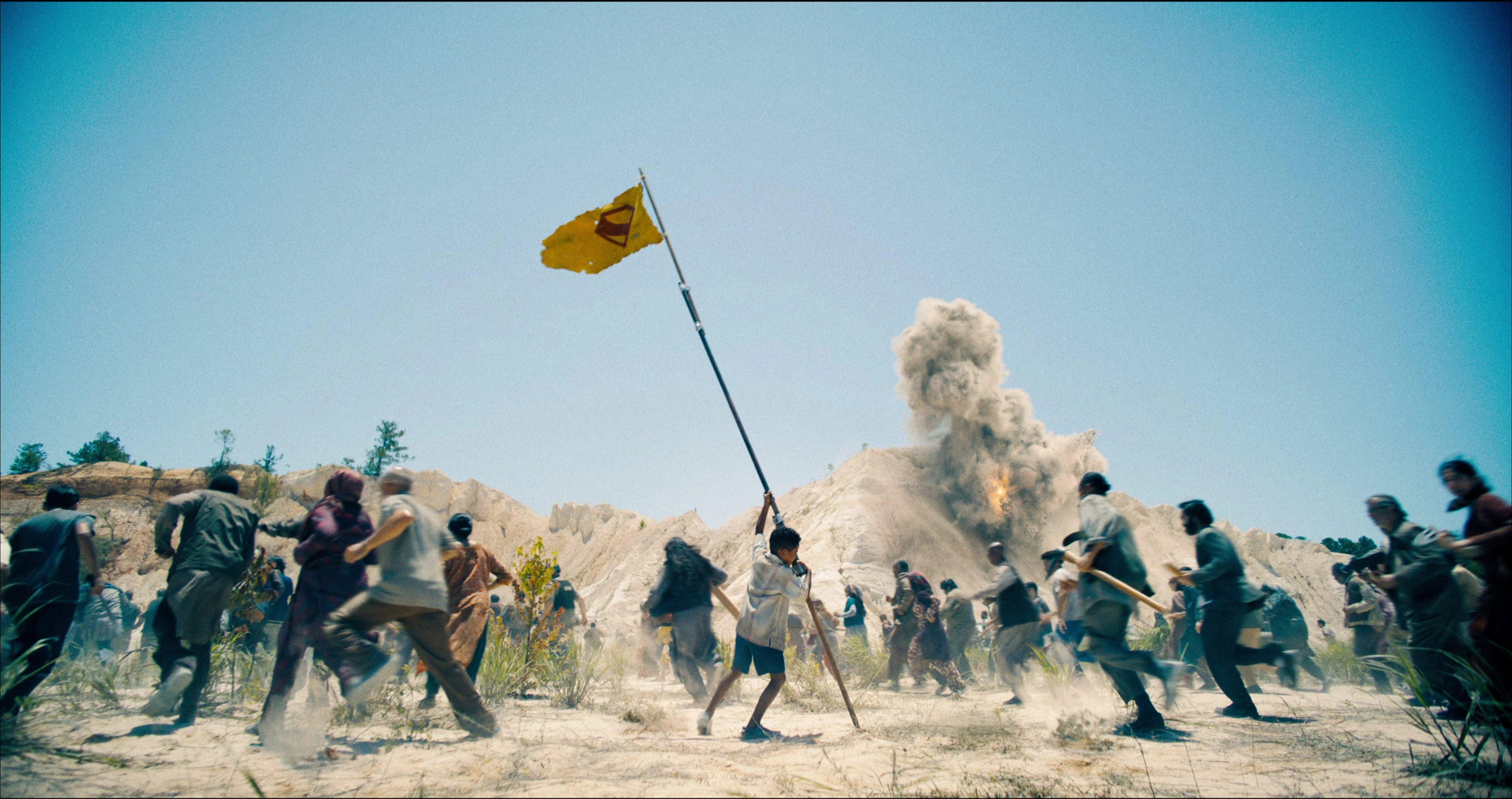
For Clark Kent — for Superman — there’s nothing to talk about. His philosophy is simple. The suffering of any sentient being, whether young or old or brown or human or Martian, is unacceptable. And if Boravia invaded Jarhanpur, people were going to die. Superman does not let that happen. It would defy his nature. So he stopped it from happening.
This simple, almost child-like approach to morality might strike you as deeply goyisch. Nothing is ever so simple in Jewish debate. Nor does Superman himself come across as a canonical Jew. He is gullible, strong, clear-headed and morally certain — everything that the nebbish is not.
There is a joke about goyim2 recounted by Devorah Baum3. It goes like this:
Two gentiles run into one another in the street.
“Hi, John. How are you?”
“Oh, hello, Freddie. I’m fine, thanks.”
For Jews, the sheer possibility of that conversation is a punchline. And it is exactly the kind of conversation that Superman would, one assumes, find delightful. Woody Allen doesn’t get to play Superman — he cracks a joke behind Big Blue’s back, then monologues into the camera about his psychosexual angst.
But the guy playing Superman this time, David Corenswet, is Jewish. This fact has not been discussed much, outside of Jewish publications. It is important, though, and fitting; for despite Superman’s appearance and Gentile demeanor, he has always been Jewish to his core.
Emet | Met
If your interests, like mine, also somehow have fallen into the center of a Venn diagram between Jewish folklore and DC Comics, then you’ll know the story I’m about to tell. Hang tight, though. I’m going to give the standard spiel, and then I’m going to tell you why it’s mostly wrong.
There’s no disputing the basics. The creators of Superman, Jerry Siegel and Joe Shuster, were the children of Jewish immigrants from Eastern Europe. Both of their fathers ran clothing shops and worked as tailors. Jerry’s family initially lived in New York. But his father died terribly young, after a shoplifter punched him in the chest and triggered a fatal heart attack. The family moved to Cleveland. There, Jerry met Joe.
It is said that Jerry was inspired to create Superman, in part, because Superman could have saved his father’s life. But Superman was also created at the height of global anti-semitism, in 1938. His Krpytonian name is Hebrew — Kal-El, meaning Son of God — and his delivery to Earth mirrors infant Moses floating down the Nile.
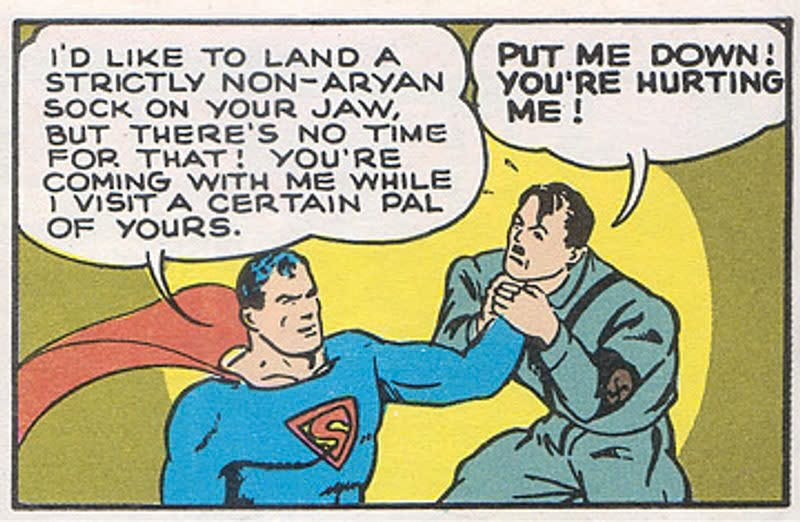
In 1941, Siegel and Shuster published a comic called “How Superman Would End the War,” in which Superman destroys Nazi cannons and beats the shit out of Hitler. I imagine Jerry and Joe sitting at their kitchen tables, where their mothers waited, hands clasped, for calls from Europe that would never come. I imagine the bitter joy of drawing Superman as he punches Hitler in the gut.
This part of the story is well-trodden. Less cited — though still sometimes discussed, as in one incredible video essay by Jacob Geller — is the influence of the Golem.
The legend goes like so. Rabbi Judah Loew of Prague knelt down and stared into the empty eyes of his creation: a crude clay giant, as-of-yet lifeless on the riverbanks. He drew a deep breath and recalled the instructions shown to him by the Lord. His people were huddled in terror behind the walls of the ghetto; the Gentiles hurled curses and rocks, promising pogrom and fire and ruin.
But the righteous knowledge of Cabala would endow the Jews with a savior — an entity ordained with the strength to protect and serve his makers.
Judah began to chant the zifurim, Cabalistic summoning spells. Electric creation blazed through the body of the giant. Roaring, he sat up and looked skyward. Judah’s assistants trembled in fear. With one index finger, the Rabbi reached out and carved a word into the giant’s skull. Emet. Truth.
The eyes of the Golem flickered. “Father,” he said. “Was this wise to do?”
At base, the tale of the Golem is the tale of Adam himself: through clay and the Word, divinity summons life from the barren Earth. But the most popular incarnation, and the version that has inspired countless descendants in speculative fiction, comes from this story of Rabbi Judah in Prague. As instructed by God, Judah built the Golem to protect his people from Gentile violence. The creature stands guard at the gates of the ghetto, repelling all comers, until the Jews are no longer in danger.
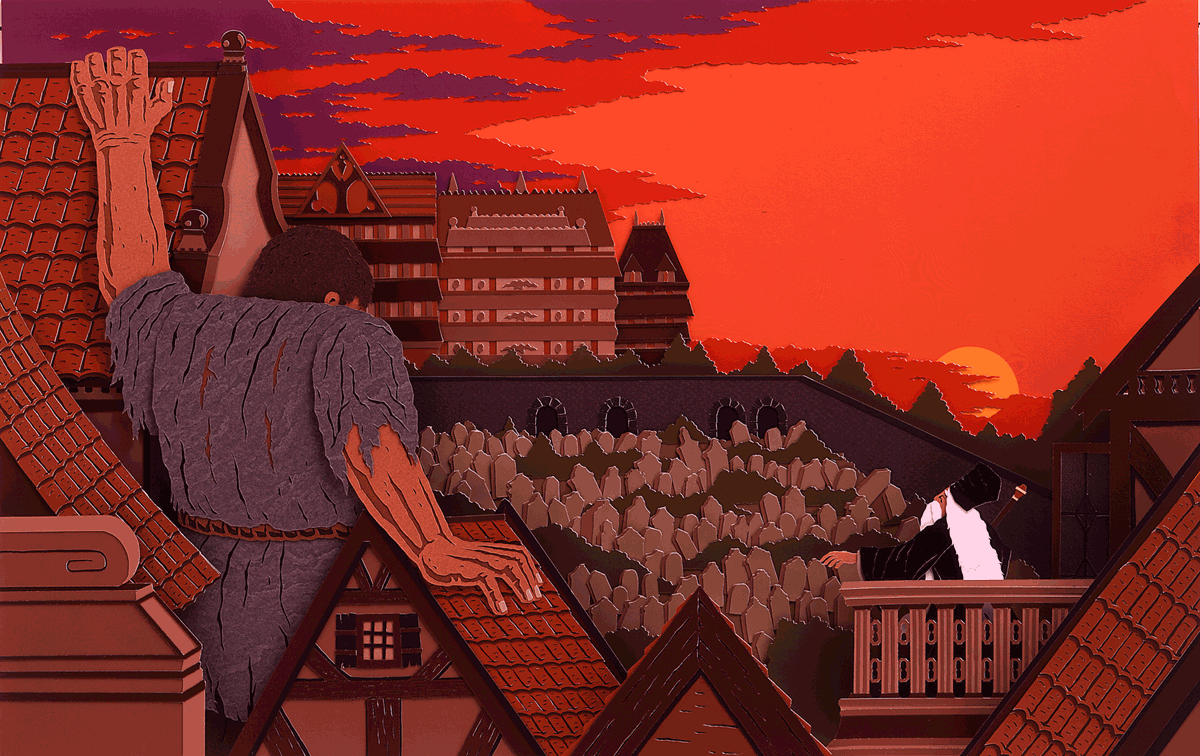
Then Judah returns him to the attic of his synagogue. He removes the first Hebrew letter from his forehead. Emet becomes Met: death. The Golem collapses. But it is said that his body still rests in the synagogue, waiting to be called forth once more.
The Golem seems to embody a principle in Jewish law called pikuach nefesh — a rule viewed as supreme above all others. It is best captured by a section in the Talmud, Sanhedrin 37a:
Adam the first man was created alone, to teach you that with regard to anyone who destroys one soul from the Jewish people, i.e., kills one Jew, the verse ascribes him blame as if he destroyed an entire world, as Adam was one person, from whom the population of an entire world came forth. And conversely, anyone who sustains one soul from the Jewish people, the verse ascribes him credit as if he sustained an entire world.
Protect your people at all costs. Treat any threat to their livelihood as a threat to the universe itself.
Through a glass darkly, this sounds a lot like Superman. Even his physical design seems to recall the creature. Famously, the “S” on his chest is a Kryptonian symbol of hope. Though he can, unlike the Golem, exist without lettering, the symbol is his figurative fuel.
But the Golemnity of Superman lies most in his impossible strength and his single-minded desire to protect the vulnerable through it. His commitment to justice is compulsive, almost programatic. It is played for laughs and, occasionally, exploited to his detriment. Literary critiques of the character like to lament this robotic morality. You can’t blame the guy. He wears his influences on his chest.
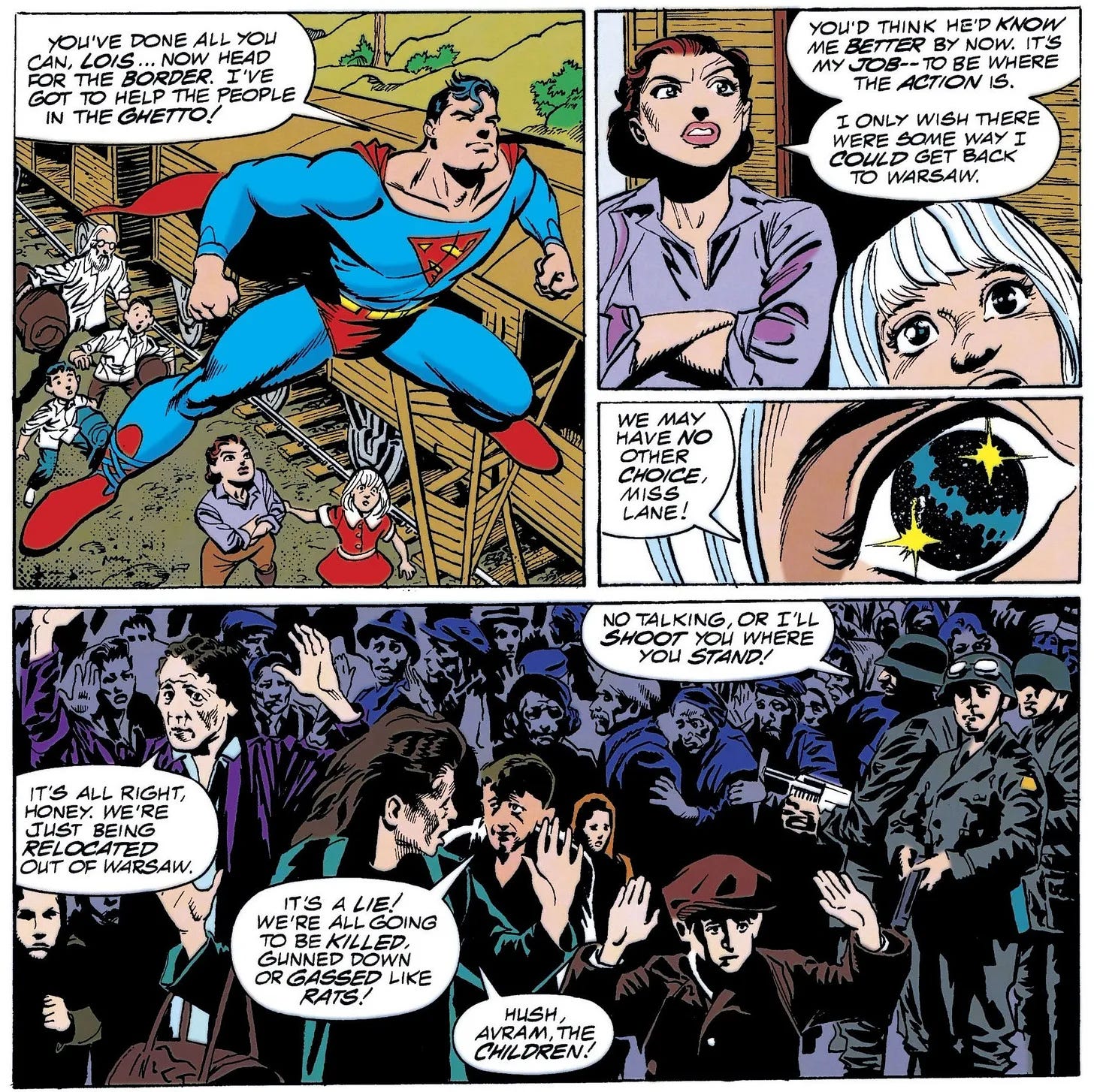
But wait — the Golem doesn’t exist to protect the vulnerable. He exists to protect the Jews. And if you think about that for a second, you’ll realize that exclusivity makes all the difference.
If the lives of Jews alone constitute entire worlds, then Jews are the only people worth saving. Any harmful act against a non-Jew is acceptable, so long as it may lead to the preservation of a Jew. Bomb refugees, shoot journalists, starve a few hundred thousand children. The Golem won’t blink. Anything and everything to protect the Chosen People.
Sound like any particular ethnostate to you?
And here lies the problem with analogizing Superman to the Golem. Rabbi Judah only summoned the Golem when faced with the unambiguous threat of genocide. He then promptly dumped it in the attic, knowing the terror it would surely wreak if allowed to prowl the streets of Prague. Why?
Because outside of one incredibly specific situation, the version of pikuach nefesh practiced by the Golem is utterly atrocious. An ideology that defends the moral status of one group alone, to the exclusion of all others? We don’t call that morality. We call it racial supremacism.
But Superman does not discriminate. For him, every life is a universe: not those of Jews alone, or humans alone, but every conscious life in existence. In the film, he spends valuable time saving a squirrel. A giant monster rampages through Metropolis, obviously beyond diplomacy; Superman tries to find a way to capture the beast without hurting it, and looks distraught when one of his colleagues drops a bomb down its throat. The death of anyone, even his greatest enemies, feels to him like an abject failure.
Compact though his morality may be, though, Superman is not stupid. He is merely unwilling to compromise his commitment to preserving life, unless it is completely, absolutely necessary. Yes, this drive can lead him into situations that seem patently ridiculous. Yet these are not the acts of a robot. They are the moral eccentricities of a saint.
What comes to mind, in such moments, are stories of the Buddhist bodhisattvas. It is said that one such enlightened man encountered a starving tigress; he sacrificed his body to feed her. Vaguely absurd, almost the structure of a joke. But we are meant to understand that the monk has not dumbly stumbled into this situation. He has made a careful moral choice, based in his infinite kindness. It strikes us as comic only because we are incapable of doing the same.
I would love to tell you that there are other translations of Sanhedrin 37a — but as far as I can tell, the version cited above is correct.
Yet here’s the thing: if you look up pikuach nefesh, virtually no one writes about it that way. It is simply too abominable. Instead, they introduce an adjustment like the following:
Whoever saves a life, it is considered as if he has saved an entire world.
A small change: but it delivers the principle from moral atrocity to the very heights of compassion. It also sounds nothing like the Golem, and everything like Superman.
Admittedly, Joe and Jerry probably did have the Golem in mind when they developed the character. The superficial similarities are too obvious, But in his morality — and his particular strain of Judaism — Superman is exactly opposed to the Golem. The Jewish heart of the Last Son of Krypton comes from another source entirely: the legend of the Lamed Vavnik.
Secret Saints
Here is another Jewish joke, from the ultimate nebbish himself: Woody Allen:
Two elderly women are at a Catskill mountain resort, and one of ‘em says, “Boy, the food at this place is really terrible.” The other one says, “Yeah, I know; and such small portions.” Well, that’s essentially how I feel about life — full of loneliness, and misery, and suffering, and unhappiness, and it’s all over much too quickly.
There are many different preoccupations in Jewish thought. One of them — perhaps the ultimate concern — is why the world should be allowed to exist at all. Life is precious, apparently. Or at least it feels that way. Yet so much is so terrible for so many people, and most of it is our own fault. Why doesn’t God just shut the whole thing down?
Because if every person is a universe unto themself, then one good person comprises a beneficient cosmos. And that, perhaps, is enough to vindicate the world. According to Jewish mythology, though, God needs a few more worlds than that: specifically, he needs 36.
At any point in history, it is said that 36 righteous people sustain the existence of the world. They are called the Tzadikim Nistarim, the hidden righteous ones. In practice, we shorten the name to Lamed Vavnik (36 righteous ones). They take on the suffering of humanity. In doing so, they justify our existence in the eyes of God.
This description makes the Lamed Vavnik seem like out-and-out messiahs, prepared to step forth and lead our species toward greatness. But the most important quality of the hidden saints — an axiomatic fact of their existence — is that they are hidden. As Rabbi Raymond Zwerin has written4:
In our folk tales, they emerge from their self-imposed concealment and, by the mystic powers, which they possess, they succeed in averting the threatened disasters of a people persecuted by the enemies that surround them. They return to their anonymity as soon as their task is accomplished, 'concealing' themselves once again.
Like the Lamed Vavnik, Superman exists to witness and, as completely as possible, alleviate the suffering of humankind. But it is essential, too, that he melts back into our presence and refuses to distinguish himself from the masses. Per one of his most famous lines: “Superman is what I can do. Clark Kent is who I am.” Clark Kent is not his secret identity. Superman is.
As readers and viewers, however, we are also never meant to think that Superman is morally superior by virtue of his abilities. Over and over, the regular humans around Superman carry out acts of kindness and bravery. And so we see that sainthood has nothing to do with strength: that even the weakest among us can carry out this version of pikuach nefesh.
For example: the recent iteration includes a character named Malik Ali, a falafel vendor. After Superman is pummeled by a Boravian foe, Malik runs through traffic to help him up. Later, Lex abducts him and holds him at gunpoint while interrogating Superman. Malik tells Superman not to give in; Lex shoots him in the head. Later, we see a front-page article about Malik’s heroism, formatted identically to an article earlier in the film about Superman.
This concept is crucial for the story of the lamed vavnik. They can be anyone: a superhero, perhaps, but also a bus driver, a blind beggar, a sewage worker. Similarly, when Malik sacrifices himself to protect the Great One, we see him as more than a mere aspirant to heroism. Superman is what you can do. The power of this version of pikuach nefesh rests within us all.
Of course, the possibility that any stranger on the street is one of the saints also means that you must treat everyone — every person on Earth — as a potential pillar of the world’s existence. That, too, is the beating heart of Superman. Every life is not just a universe; it could be the foundation of the whole damn thing. So if you really believe in the thirty-six saints, there’s only one way to go. You must act like every life is the most precious entity in the universe. You must mourn for the unneeded loss of a single innocent soul. You must act, in other words, like Superman.
What I love about this legend is that for the Lamed Vavnik to carry out their work, they have to live in the Diaspora. The Golem, in his racial logic, fits perfectly in modern Israel; in many respects, his character and the ethos of the modern state are pretty much indistinguishable.
But to motivate the goodness of the world, the Lamed Vavnik need to spread themselves all over the globe. If they all sit in Israel, you know you won’t meet one in Gaza — and so the motivation to protect people in Gaza vanishes, seeing as no one there could possibly be one of the holy. But if every father waiting in line at the aid station could, in fact, be a member of the 36, a cynical bullet could spill the blood of a saint. You don’t know; you can’t know; and that is reason enough to lower the barrel of your gun.
Like his creators, and like the Lamed Vavnik, Superman is a proud product of the Diaspora. He is embedded within the great mass of humanity and infinitely better for it. He is raised by goyim; his love for them endows him with the kindness for which he is loved and revered. Superman would not be Superman if he lived only to defend Kryptonians.
In that case, we would class Superman alongside General Zod. We would call him a villain. We would call Superman a monster.
The S doesn’t stand for Shalom
So: the S stands for Shtetl. Superman likes a good deli. But what can his diasporic Judaism tell us — the real, life-and-blood Jews trying their damndest to be good people, while so many of their brothers and sisters talk in grinning, bloody circles about why murder is sometimes the answer — about the nature of our creed? Amidst the destruction of Gaza, what does it mean to be a Jew?
Not humor, or reason, or resilience. Not Woody Allen movies, or the Marx Brothers, or Seinfeld or Larry David. Not arguing for the sake of arguing. Not “people of the book.” Not science or chess or literature. Not kugel. Not Shabbos. Not Israel.
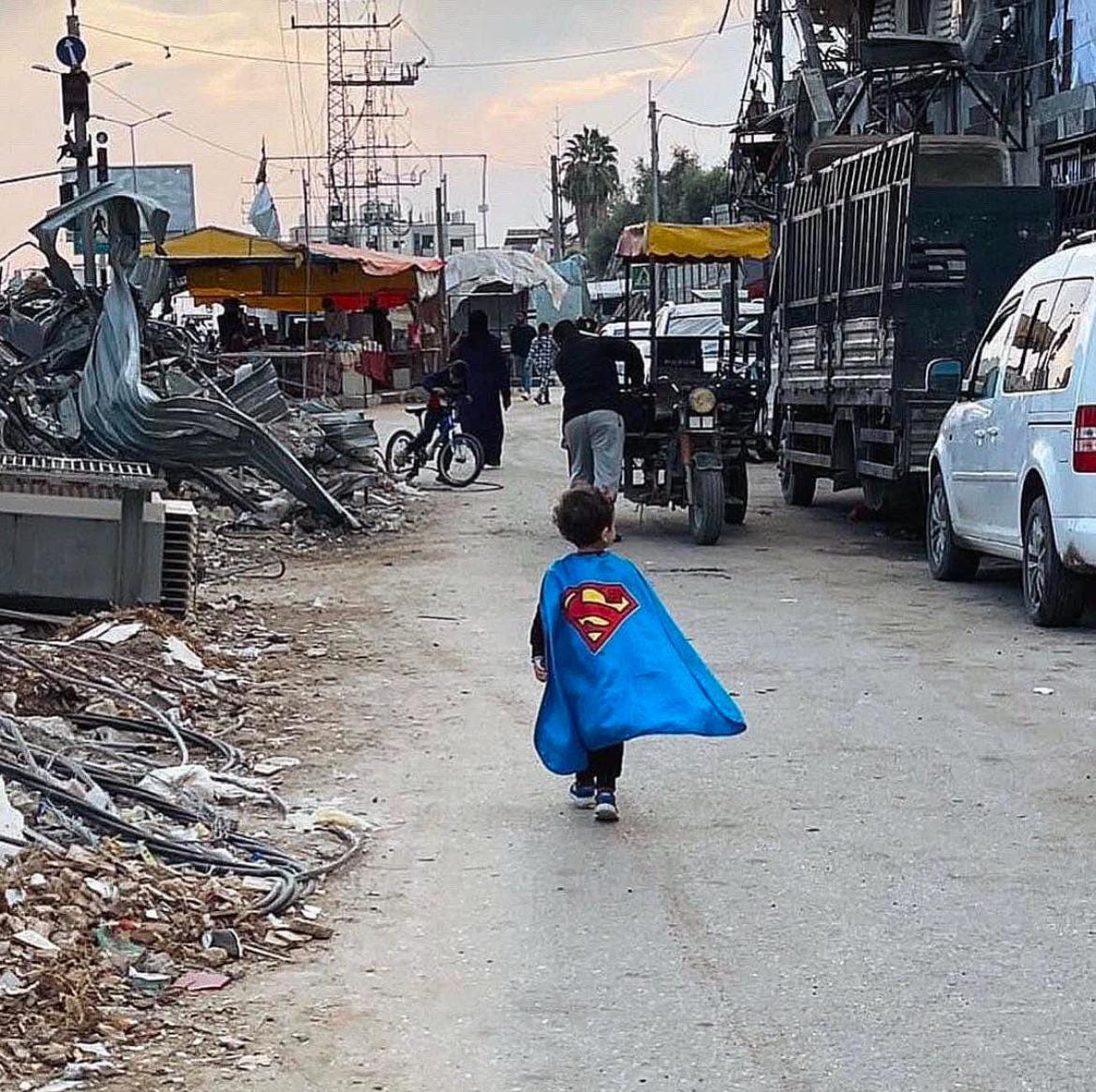
Being a Jew means treating life — not Jewish life, but all life — as the most sacred property in the universe. Being a Jew means treating any claim of “self-defense” or “preemptive action” that results in the suffering of others with the utmost skepticism: rare are the days when pikuach nefesh is violable. Being a Jew means despairing over the prospect of one solitary child, let alone thousands, starving in a ruined street. Being a Jew means finding it simple, straightforward, completely and utterly uncomplicated to oppose murder in any form.
Or at least, that’s what Superman would say. It is also what many Jewish people have been saying and practicing for decades.
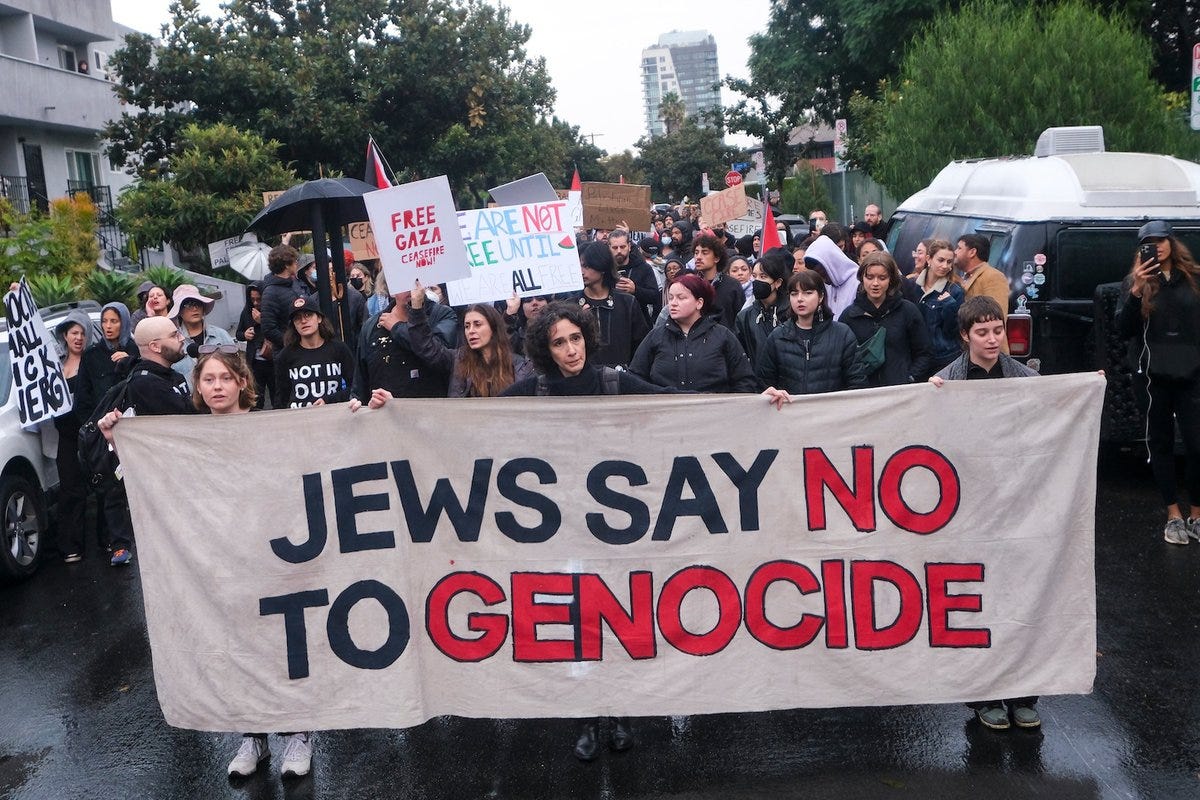
Increasingly, there is a tribal divide. On one side are Jews who defend the complete autonomy of Israel, identifying all military acts — even an occupation that is now generally viewed as genocidal, even by human rights groups within Israel itself — as defensive, at least plausibly necessary for the preservation of Jewish life.
On the other side are Jews who recognize that so-called self-defense can justify any atrocity, as it has repeatedly throughout human history. As the great Noam Chomsky has surmised: only in philosophy textbooks does morality hinge on intention. In real-life, you can usually judge people by what they do, not what they claim to be doing. Annihilating Palestinians is not “self-defense” or “preemptive action.” It is exactly what it looks like. It is an act of pure brutality that Superman would — and in the film, literally does — seek to prevent.
The divide, in other words, is between the Golem and the Lamed Vavnik: between mindless, cynical self-preservation of one’s tribe at any cost to others, and compassion for humanity as a whole.
The people of the Golem like to call their counterparts “self-hating Jews,” “bad Jews,” “fake Jews” and so forth for considering the moral worth of Gazans alongside their own. When I see these comments, I think of another joke:
On a bus in Tel Aviv, a mother is talking to her small child in Yiddish. But he keeps answering her in Hebrew. Each time, his mother corrects him: ‘No, no, talk Yiddish.’
An increasingly exasperated Israeli, overhearing all of this, demands to know, ‘Why do you insist your son speaks Yiddish instead of Hebrew?’
‘Because, the boy’s mother replies, ‘I don’t want him to forget he’s a Jew.’
Of course, there’s a hole in my argument — the version of pikuach nefesh that, I’ve argued, makes Superman identifiably Jewish, doesn’t correspond with the original text. It is a retcon by scholars who justifiably refuse to accept ethnocentrism as the highest law in their religion.
Then again: how many paragons of Jewish culture hold their status by way of piety? In Devorah Baum’s book of Jewish jokes, half of them are about disdaining God and the Torah.
In the Superman film, too, Clark discovers that the message sent with him by his parents — his holy text — is not what it seems. The version he thought he received is the pikuach nefesh of the Diaspora; but it contains a secret second half that turns it into the principle of the Golem, demanding that he use his superior strength to turn Earth into a new Krypton for his progeny.
But Superman doesn’t play by those rules. At the end of the movie, he asks his servants in the Fortress of Solitude to play the message from his parents. The camera pans out. He isn’t watching the video from Krypton. He’s watching home movies from his childhood in Smallville, Kansas.
If the original version of some winding passage in the Talmud does, contra all modern interpretations, justify the arbitrary death of innocents, then burn it. I don’t need a scroll to tell me what it means to be Jewish. I’ll stick to DC Comics.
Many thanks to Ethan Wellerstein, Noah Stark, and Benji Stark-Elster for comments on an earlier draft of this essay.
I use this term not as a direct insult toward non-Jews, but to stick with the attitude expressed by the joke, which is meant to (A) parody the straightforward friendliness of Gentiles and (B) poke fun at the inability of Jews to have a straightforward, friendly conversation with each other sans kvetching.
From The Jewish Joke: A Short History with Punchlines.
Zwerin’s entire sermon is worth reading — he summarizes the lesson of the Lamed Vavnik better than anyone else.
I'm very late to the party, but this was marvelous and it would be wrong to not tell you so.
I am such an easy mark for explorations of how comics draw upon and interpret social issues, so I devoured this essay. Have you ever read "The Amazing Adventures of Kavalier and Clay" by Michael Chabon? It draws upon a lot of the Siegel/Shuster and golem mythology. Your piece is a cool counter/companion.
Also, your writing is so emotionally compelling! I immediately sent this to several friends. Thanks for writing it. :)