


After a long hiatus, Unpublishable Papers is back and posting every other Monday! Stay tuned for new biweekly articles, though I may get overzealous and publish some extras.
A couple months ago, a writer named Étienne Fortier-Dubois released a quixotic and totally fascinating project — The Historical Tech Tree.1Beginning from the Oldowan Hand Axe, Étienne traces our technological lineage across nearly ~2000 (and counting) discrete inventions, with each new technology marked by a date, a Wikipedia link, and a set of ancestors and descendants. Film cameras burgeon from revolving guns; the first attempts to create flying drones appear, surprisingly, in the early 1900s. It is incredibly cool, and I’m very excited to see how it develops.
But there’s also a question inspired by the Tree that I can’t get out of my head. Let’s picture ten million alien species distributed randomly across the universe. We make no assumptions about their biology, the structure of their planets, or anything else save the following: each species is (A) totally isolated from its peers, and (B) continually seeking to advance its collective technological complexity.
The aliens also all have their own personal Étienne. The Étiennes diligently record Tech Trees for their home civilizations. For this scenario, we’ll assume that the Tech Trees are perfect records of technological evolution — so each civilization’s Tree has a correctly annotated node for every discrete technology.
Infinite time passes. All the species advance as much as they can.
Eventually, they manage to get in contact with each other. They decide to hold an inter-galactic conference of Étiennes, with the aim of finding out if any technologies have inextricably appeared on every Tree. Based on these comparisons, they create a master Tree. If a node appears on every individual Tech Tree, then it will also appear on this copy. All other inventions are excluded.
What, if anything, should we expect to find on this Universal Tech Tree?

We’re ready for to go
As far as I can tell, this particular question has not really been explored by anyone else. But a useful starting point is to look at how scholars have thought about the measurement of civilizational advancement — that is, how one might compare the human level of advancement to that of a hypothetical alien species. These schemas are helpful because they identify properties that might be inherent to civilization per se. Therefore, we might expect technologies related to these properties to appear on every Tree.
Of course, recurrent technological categories are different, and perhaps less consequential, than recurrent technological nodes. The claim that all civilizations will engage in “energy production” is more abstract than the claim that they will all invent nuclear fission. So we begin with a coarse-grained question that will, in turn, help us to narrow into the granular answers we seek.
Let’s start with a story about music. In 1963, Soviet astronomers recorded radio waves from CTA-102, an unidentified extrasolar object. Further observations revealed that the radio waves varied every 100 days — a ridiculously short span, never before discovered in a non-human source. On April 12th, 1965, the scientists declared that the waves might be signals of an alien species. One of them, Nikolai Kardashev, said that “a new supercivilization had been discovered.” This announcement caused a minor worldwide sensation.
Later investigations soon deflated the hype. The waves were coming from a quasar: a massive black hole at the center of a distant galaxy. To many skeptical scientists, this was both more reasonable and deeply interesting in its own right. To the public, though, including a folk band called the Byrds, it was slightly disappointing. The Byrds released a song called CTA-102. Some of the lyrics went like so:
We just want to let you know
That we’re ready for to go
Out into the universe
We don’t care who’s been there first
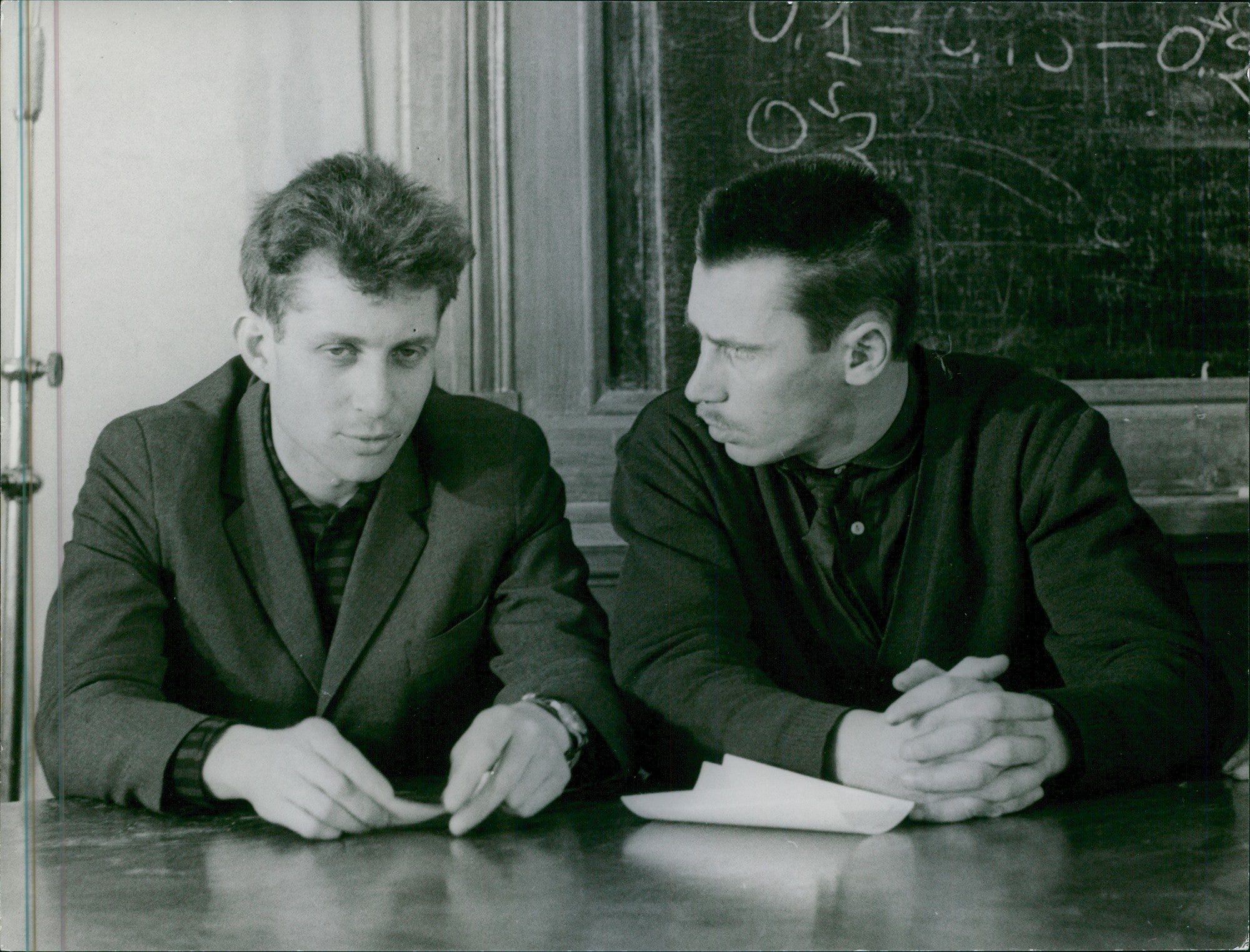
Among the hippie sympathizers, presumably, was Kardashev. A young graduate student at the time, Kardashev had drawn from CTA-102 to write a 1964 paper called “Transmission of Information by Extraterrestrial Civilizations.” His paper included a typology of civilizational advancement, which divided civilizations into three categories:
I – technological level close to the level presently attained on the earth, with energy consumption at ~4 x 10¹⁹ erg/sec.
II – a civilization capable of harnessing the energy radiated by its own star (for example, the stage of successful construction of a “Dyson sphere”); energy consumption at ~4 x 1033 erg/sec.
III – a civilization in possession of energy on the scale of its own galaxy, with energy consumption at ~4 x 1044 erg/sec
CTA-102, Kardashev proposed in the paper, was the energetic signal of a Type II or III civilization. He was wrong.
But the Kardashev scale has prospered, and now serves as the theoretical backbone for many attempts to speculate about the structure of alien civilizations. Its longevity probably stems, in part, from the sheer difficulty of saying pretty much anything about the nature of intelligent aliens, given our sample size of 1. But if those hypothetical aliens want to continually advance in technological complexity, they will need lots and lots of energy for the job. Kardashev hit upon one feature of civilization that seems potentially axiomatic.
Which leads us to a key characteristic of the Universal Tech Tree — it should contain nodes for technologies related to the production, storage, and exploitation of energy.
Gotta Make Things Go Boom
Imagine the space of all possible technologies. Some are completely trivial, others disgustingly complicated. But all of them absolutely require energy to produce and use. If a civilization seeks to advance its technological complexity, then it definitionally seeks to explore that possibility space of technologies. One limiting factor is energy; if they cannot produce, store, or exploit enough of it, then the civilization will reach a technological bottleneck.
This has arguably already happened to the human species. Further advances in certain branches of physics will require us to smash particles together really, really fast. Whether we make those advances therefore depends on whether we can harness enough energy to smash the particles fast enough. Right now, we can’t. Check back in 2070.
Please note that I am not saying technological complexity itself is equivalent to amount of energy consumption. Two civilizations — say, two versions of humanity — could produce the same amount of energy. But if one version also produces a bunch of random and marginally useful nonsense, like curtains and baby powder, then that civilization is arguably more complex by virtue of its open-endedness. They have more widely explored the space of possible technologies, even if many of those technologies are somewhat trivial. To my mind, complexity is a mix of both how deeply and widely a civilization has explored the possibility space.
Instead, I am saying that energy is a limiting factor on technological complexity. Greater and more efficient use of energy means more complete exploration, and therefore more complexity. You can only keep advancing if you get better at making things go boom.
In this vein, energy is the most obviously essential category. But a civilization also needs to use that energy effectively. To do that, they need to generate, process and store lots and lots of information.
Everything is computer!
In an essay about his Historical Tech Tree, Étienne notes that every node on the Tree stems from another node. Of course, serendipitous inventions do happen, as with the vulcanization of rubber. But generally, innovation requires us to build upon previous innovations — which means that the efficient production, access, processing and storage of information is absolutely crucial. Invention depends on recognizing and recombining previous inventions. You won’t get far in that process if you don’t have something like a library to keep track of what’s come before.
In short, energy isn’t good for much if you don’t know what to do with it. Some revisions to the Kardashev scale have accordingly attempted to incorporate informational capacity into his categories. Most examples focus on the sheer amount of information available to a species: literally, the number of bytes contained in books, films, photographs or alien equivalents thereof.
I don’t find this particular approach compelling. The Library of Babel — a hypothetical library imagined by Jorge Luis Borges, which contains every possible combination of English letters across a huge (though finite) number of 410-page books — has a lot of information inside it. Specifically, it holds something like 19851067×101918648 YB (yottabytes) of information. Current estimates suggest that humanity has generated about 181 ZB (zettabytes). One zettabyte equals .001 yottabytes. So, a user walking the Library of Babel has way more information available to them than someone granted access to the existing archives of human information.2

But the story of the Library, famously, is about how it’s nearly impossible to find a single book that contains even a shred of meaning, because there is no organizational system to guide one through it. Yes, the Library contains a theory of quantum gravity. But it also contains billions of incorrect theories, as well as mountains of jibberish. Without a system for navigating the library, you’ll probably find nothing but crap.
So, sheer amounts of information do not signal higher levels of advancement. Efficient storage and processing is just as important. I’m not the guy to figure out how to quantify those qualities for a refined Kardashev scale. But it would be cool if somebody did!
Alongside energy technologies, then, informational technologies should appear on every Tree. Information is just as much of a potential bottleneck as energy.
Some Honorable Mentions
Energy and information are unquestionably the two most salient technological categories for the nodes on a Universal Tech Tree But over the years, mainly through revisions of the Kardashev scale, scholars have indirectly identified other possible groupings. Below are a few examples and why they’ve been excluded:
Population
Carl Sagan suggested that the number of individuals contained in a species might also relate to their advancement. Drawing from the examples of energy and information, we might then propose that technological categories for increasing population — like medicine, perhaps — should appear on every Tech Tree. The literature on cultural evolution has repeatedly reinforced that population size is a correlate of group-level innovation. The logic is pretty obvious: more people means more ideas.
But when it comes to alien civilizations, we can’t assume that their innovative capacity relates to population metrics in the same way. Who’s to say they even have individual members? Maybe some species are just giant slime molds, or intelligent oceans. If they all do have individuals, then maybe most of the population consists of mindless drones, and innovation depends on a select number of eusocial queens endowed with the rare gift of a brain. In these cases, higher populations would not do much for technological complexity.
Micro-control
Inverting the Kardashev scale, John Barrow proposed that more advanced civilizations would learn to control increasingly minute features of reality. First, they can manipulate objects at their own scale, before descending down to the level of genes, molecules, and so forth down to the building blocks of spacetime itself.
I really like this idea, but two flaws come to mind. The first is nitpicky and not my reason for excluding Barrow’s proposal— who’s to say aliens would possess something like genes to manipulate in the first place? That’s a pretty strong assumption about the universal laws of biology.
The second problem is more fundamental — who’s to say aliens would perceive these scales discretely at all? Maybe that’s a quirk of human perception. I’d bet that any advanced species would recognize different spatiotemporal scales of reality in roughly the same fashion as us. But it still relies on assumptions about alien biology that we cannot safely make. So, no micro-controls on the Universal Tech Tree.
Mobility and territorial reach
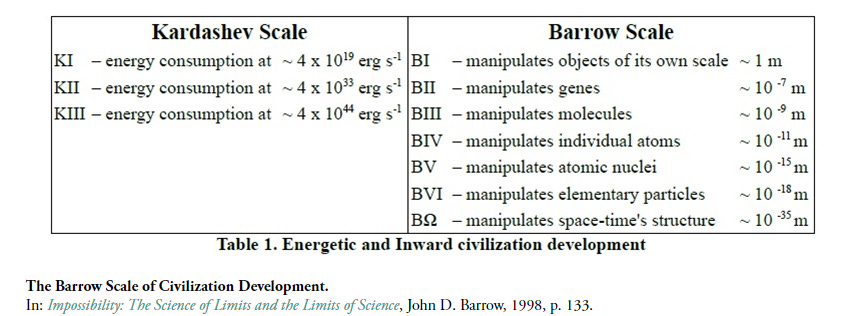
As a corollary of energy consumption, perhaps greater complexity requires the continued spatial expansion of the species. If so, technologies like rocket propulsion might appear on every Tree. The logic here, I think, would be that a larger territorial reach provides access to the energy resources necessary to continue exploring the space of possible technologies.
But per Barrow, this isn’t necessarily true. Maybe it’s way more efficient to get energy from quarks, and some civilizations ignore the fun of building a Dyson sphere. We don’t know if bigger energy sources are actually better energy sources. Without that driving assumption, technologies for greater mobility and territorial reach don’t necessarily appear on the Universal Tech Tree.3
Missing the Leaves for the Branches
Based on the above, we can make a modest proposal. All civilizations capable of continued technological advancement will, at minimum, create technologies that (A) are not contingent on any particular physiology, planetary structure, or other variant qualities, and (B) otherwise constitute impassable limits on their ability to generate greater technological complexity.
Okay, great. From this proposal, we can hopefully agree that all civilizations will have to manipulate energy and information. But again, “energy” and “information” are not actual nodes on a Tech Tree. They’re categories into which one can place certain kinds of technologies.
The really interesting question is whether any specific nodes appear on the Universal Tech Tree. Good candidates would be inventions that constitute essential advances in the use of either energy or information — innovations that, if never found, would forever limit the technological advancement of a civilization.
The current iteration of the Historical Tech Tree is obviously not a perfect record of technological innovation. But I suspect that several nodes present in the partially developed version would appear on the Universal Tech Tree, because they are just that fundamental to how a civilization can use energy or information.
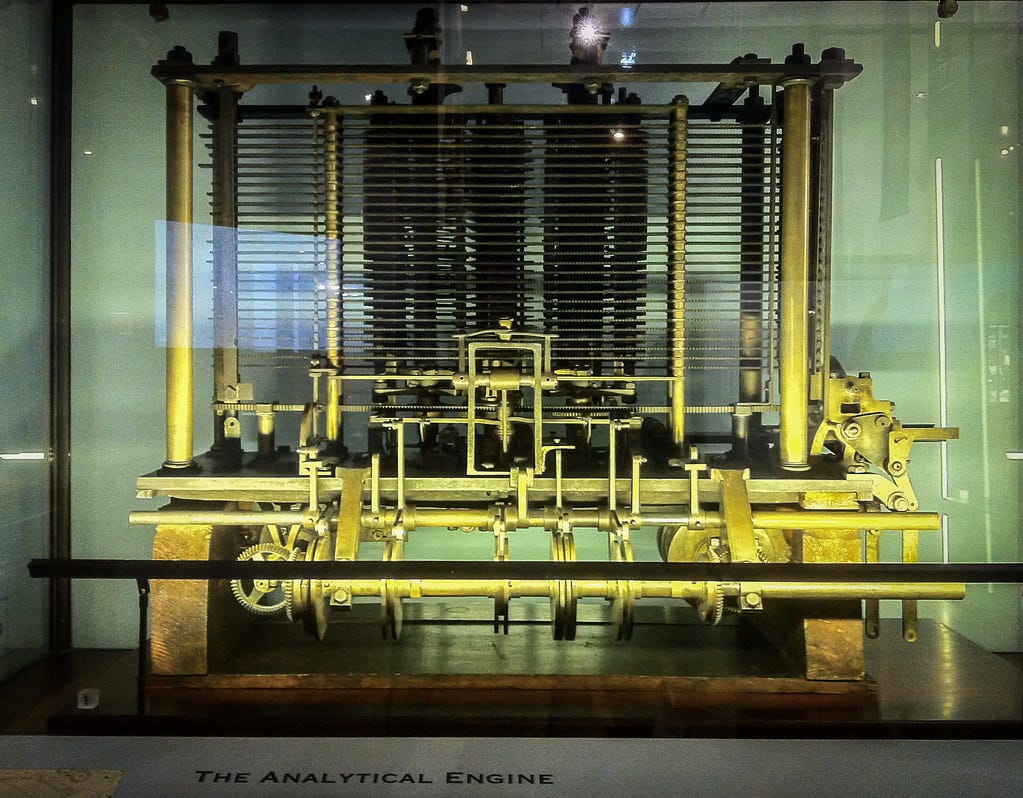
As an example, consider the invention of the computational algorithm. On the Historical Tech Tree, this innovation is represented by Note G, an algorithm for calculating Bernoulli numbers. Note G was one of seven supplements contributed by Ada Lovelace to her translation of a lecture by Charles Babbage, in which he outlined his “analytical engine.” The engine is now viewed as the first design for a general-purpose computer, which makes Lovelace’s note the first known computational algorithm — among humans, at least.
Why should computational algorithms appear on the Universal Tech Tree? Ostensibly, because mathematics is one area of thought in which intelligent aliens, no matter how distinct from us, would develop some ideas similar to our own. The definition of a prime number, for example, does not depend on human biology; it follows from the nature of numbers themselves. Consequently, the revelation of intelligent aliens in Contact, the science-fiction novel by Carl Sagan, comes when scientists at SETI record a stream of prime numbers coming from Vega.
If we trust that all alien civilizations would therefore come upon certain mathematical ideas — like calculation and the notion of logical correctness — then, assuming they have enough energy and information available to keep advancing, they should definitely hit upon a theory of computation, since computation is just an automated version of processes they’ve already developed. And once you have computation, algorithms soon follow. So, a node for Note G — or rather, “computational algorithm” — should appear on the Universal Tech Tree.
To suggest that other existing nodes on our Historical Tech Tree would appear on the Universal Tech Tree, we should be able to make similar arguments as for Note G. The node must follow from fundamental features of mathematics (or the physical structure of the universe), and its innovation should constitute a massive, unskippable advance in the energetic or informational capacity of a civilization. They should also be discoverable without possession human biology. Examples could include: nuclear fission, nuclear fusion, nuclear power, the Turing machine, and quantum computers.
Hopefully, you’re now convinced that the Universal Tech Tree is not barren. There are at least a few leaves, here and there. The conference of Étiennes is not a total bust. But I want to raise another, much more speculative idea — all technologically complex aliens will be endowed not only with certain technologies, but certain cognitive capacities. In other words, if we receive a clear signal from intelligent extraterrestrial life, we can assume that their minds work, in some respects, like ours.
This claim relies on our understanding of cumulative cultural evolution (CCE): the process by which the technological complexity of a society increases, as their technologies are stably passed down from one generation to the next, refined, and expanded into greater utility and new functional domains. Depending on who you ask, CCE is either partially or totally unique to humans. Crows can socially learn and improve upon recipes for tools; whale songs oscillate in complexity over many generations. But humans are the only species on Earth that could attend the conference of Étiennes. We continually cultivate our technologies to an unmatched degree of intricacy, because we alone can engage in true CCE.
If cumulative culture is a prerequisite for advancing technological complexity, then it seems reasonable to assume that any alien civilization would also develop their technology through a similar process. In fact, the structure of a Tech Tree seems to logically imply CCE. Node-by-node, technologies expand from their stabilized ancestors. We could therefore plausibly say that any society capable of filling in a Tech Tree would do so through cumulative cultural evolution.
Some of the cognitive features that make humans technologically unique on our planet, then, might also have to recur in any advanced civilization. Our planetary uniqueness may help us identify intergalactic similarities.
The Stars Our Destination
To end on a call for scholarly action: I have been struck, while writing this article, by how rarely my home field of cultural evolution seems to engage with questions of astrobiology. Some of the same concepts actually appear in both domains. In A Theory of Everyone, Michael Muthukrishna basically adapts the Kardashev scale to discuss the relationship between energy and technological advancement in human societies. Discussing the sources of various cultural universals is also now common-place in anthropology. Surely, it is a short-ish hop from thinking about cultural universals across human societies to cultural universals across any society.
Perhaps the most relevant discussions come from the burgeoning literature on the nature of intelligence. But no one in that world has, to my knowledge, made any direct assertions as to what their research suggests about the structure of extraterrestrial civilizations.
The reasons for this reluctance are pretty straightforward: we only have data about one advanced civilization. Until that changes, all theories are completely and obviously speculative, including this post.
Yet speculations about astrobiology, no matter how unpublishable, are valuable. If we manage both not to destroy ourselves and to continue advancing our technological complexity, the Great Silence may well end: we may find records of a civilization like or beyond our own. If that happens, it will be extremely useful to have a body of theory to build from, just as it was useful to theorize about cosmology before we had developed telescopes and rockets.
And if it doesn’t happen? Well, thinking about this stuff is still lots of fun. Science can always use more of that.
Many thanks to Étienne for comments on an earlier version of this article.
For sticklers in the audience, I will note that the Library of Babel could also be compressed into a pretty succinct algorithm which, if run for long enough, would then generate the entire Library. In that sense, it has a much lower information content than the present human archives. But the point still stands: the informational capacity of a civilization is just as much about organization as it is about sheer quantity.
One counterargument might be that all lifeforms seek to fill their ecological niche; they’re endowed with an “expansion drive,” which would necessarily push any intelligent species to press outward as widely as possible. But it is not obvious — to me, at least — that this would necessarily apply to extraterrestrial life, even if it is potentially true for terrestrial life.
Curious to know thoughts on the so called Great Filter. Are there any technologies that are contraindicated to a species’ survival? Are there correlates of a Great Filter when it comes to persistence of an earthly cultures as well?