
Everything's funny and nothing hurts
On the weirdness and (im)morality of dark humor

In 2019, I visited my best friend from high school, and we decided to assemble a team to play in a dodgeball tournament at his college. We put on backwards hats and oversized tank tops decaled with phrases like Saturdays are for the boys, blasted Biggie Smalls off a JBL speaker, and made our way to a packed gymnasium. My friend demonstrated his “specialty” throws on the walk over.
In the center of the gymnasium, there were three adults holding microphones. They waited for the crowd to settle. Then they said: “Welcome to the Micah Parsons Memorial Dodgeball Tournament. Thank you for being here to honor Micah’s memory.” They explained that Micah was a former student who had died of an accidental overdose. On the night of his death, he had been refereeing a dodgeball tournament — hence the occasion.
And I started laughing: not out loud, but I did cough and bite the inside of my cheek. My friend saw this and almost choked on his own spit, because now he was laughing too. So a vicious cycle of trying not to laugh, seeing each other trying not to laugh, and then needing to try even harder ensued, all while the adults, at least one of whom was a family member of Micah’s, explained how much it would mean to him to see us all there in the bleachers.
Thankfully, the speech was short, and we were soon free to chastise each other and lose several games of dodgeball. But I still think about my reaction, five years later. Why couldn’t I hold it together? And why did no one else — save my friend, also a (potential) psychopath — respond the same way?
The broadest version of this question is why some varieties of pain are so funny. Then there’s the more specific question of how some people apply dark humor – always funny, in fictional contexts — to reality. But the most important question, for me, is whether it’s bad to laugh so hard and so often at pain. Because I do laugh. So do most of the people I love, even when we’re laughing about pains that are deeply personal. Are we — am I — pathological? Cynical? Hyperaware? Immature?
Here’s what I know; I feel better laughing than not, perhaps because
if you’re laughing then you must be safe
You’re a chimpanzee playing with someone else in your group. Playing often looks and feels like fighting, which is something else your species does. So you’d like to make sure your playmate knows you don’t mean any actual harm, and you’d also like him to confirm that he also means well. What do you do?
You laugh: or so says Richard Provine, a neuroscientist at the University of Maryland. Provine studies the evolution of laughter, and he believes that one key function underlying the vocalization — which appears in highly social species like humans, dolphins, apes, dogs, and rats — is to relieve tension for yourself and others by signaling that everything is okay. Non-human animals mostly laugh when engaged in aggressive physical play: fighting, wrestling, chasing. Hence the importance of reminding each other throughout that you’re just having a little fun.
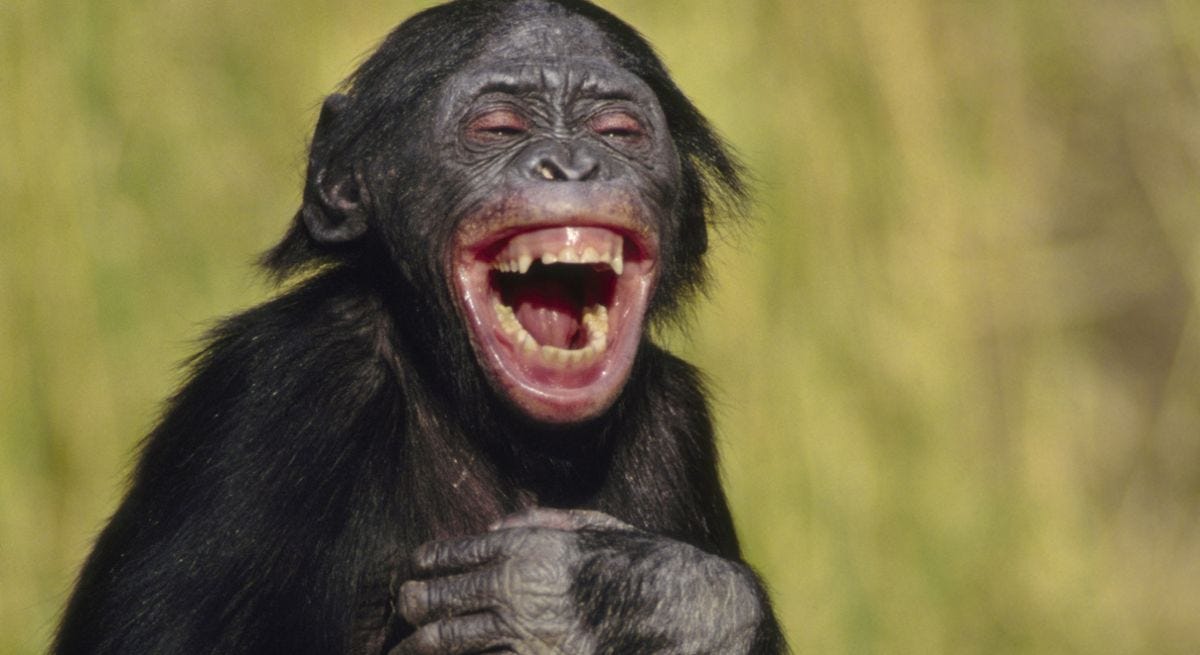
Laughter seems to play a similar role in humans. In one study, Provine observed laughter by strangers in public spaces; and he found that in most cases, people were not laughing at anything ostensibly funny. Instead, they laughed throughout basic social interactions: alongside a greeting, after making a point in a conversation, and so on. Perhaps laughter remains a way to continually affirm our intentions and amiability — to relieve tension, or prevent it from arising in the first place.
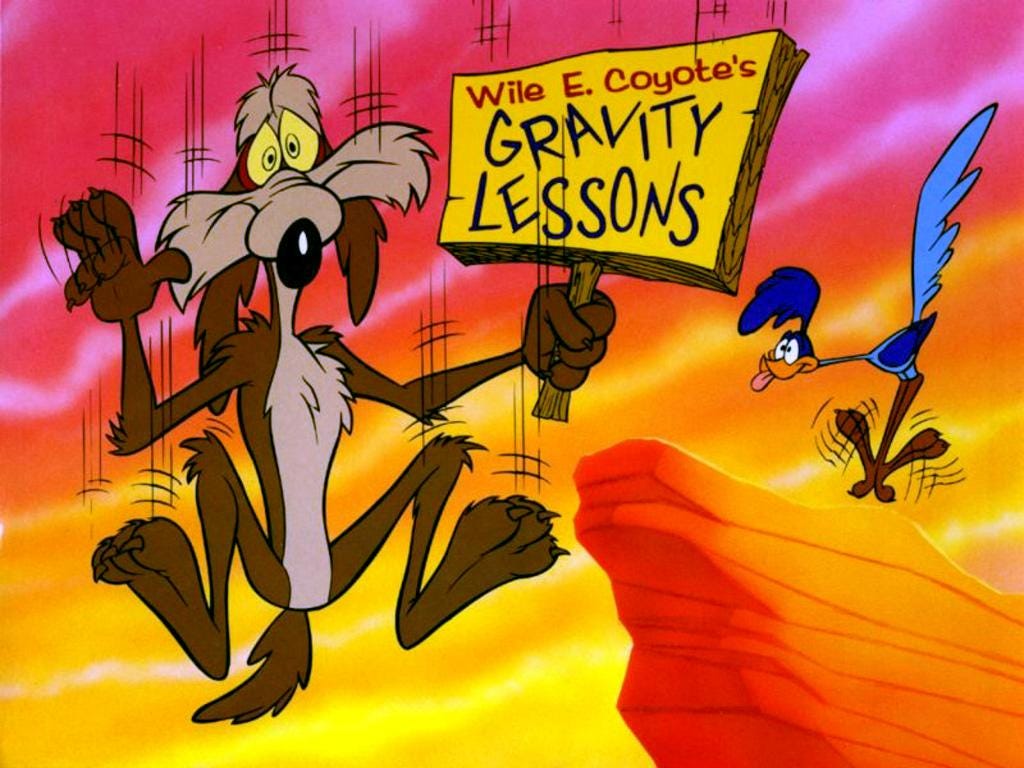
Of course, this is not a full explanation for dark humor. But it does suggest why comedy, including universally loved scenes and characters, is so often violent. Everyone laughs when Wile E. Coyote falls off a cliff, or Charlie Chaplin gets frantically dragged along a conveyor belt, or the Black Knight loses three limbs and yells “I’ll bite your ankles!” at King Arthur. All three examples are fundamentally cruel. Apparently, we laugh when the possibility of conflict appears, then dissipates.
However, Provine’s explanation is not quite complete, because tension is not always funny, no matter how completely it is relieved. You don’t laugh if a white van is following you down the street and then makes a sudden right turn. Despite the putative relief of tension, the situation is not at all funny. Yet you would laugh, perhaps, if you discovered that the van was actually an ice-cream truck driven by an elderly woman, because the other core to dark humor is
partial prediction error, or sticky brown things that are not maple syrup
Here’s a terrible joke:
What’s brown and sticky all over?
A stick.
Everyone recognizes this as a joke, in some minimal sense of the word. We can unpack those minimal conditions by comparing it to a different joke, one that doesn’t deserve the moniker:
What’s brown and sticky all over?
Maple syrup.
Why isn’t the second example a joke? Presumably, the punchline is the problem – it isn’t surprising enough. But if surprise was the key factor, then this would be a joke too:
What’s brown and sticky all over?
Spaghetti.
You don’t expect to hear “spaghetti” as the answer; but it’s too surprising to work as a joke. Rather than surprise, it’s more useful to think about partial prediction error (PPE) — humor emerges, in part, when our predictions are subverted in ways that are unexpected, but still commensurate with the basic logic we had in mind. Jokes are like crazy syllogisms.
Arguably, PPE is more basic to humor than the relief of tension. But great humor emerges when the two are combined; or more specifically, when the soon-to-be-subverted premises build in a degree of conflict. Here's one more, much better joke:
Two hunters are out in the woods when one of them collapses. He doesn't seem to be breathing and his eyes are glazed. The other guy whips out his phone and calls the emergency services. He gasps, "My friend is dead! What can I do?" The operator says, "Calm down. I can help. First, let's make sure he's dead." There is a silence; then a gun shot is heard. Back on the phone, the guy says, "OK, now what?"
In a 2002 study called Laugh Lab, in which the psychologist Richard Wiseman set up a site for people to submit and rank jokes, this one proved to be the most popular of all. Under our rough model, that makes sense — the premises introduce tension, and the tension is resolved in a partially unexpected way.
PPE also helps us better account for the brutalization of Wile E. Coyote and his ilk. Imagine if Wile E. fell off a cliff and, upon impact, shattered into a paste of bone and blood and muscle. Technically, that would relieve or (at least) end the tension of wondering what will happen to him. But it’s much funnier if he instead makes a coyote-shaped hole in the ground, then peeks out in a daze. That’s not completely unexpected, but it’s incongruous with what we expected from physics! So it’s funny. Popular dark humor, and humor generally, often follows a similar formula.
Everything is funny and nothing hurts
It is strange, then, that only some people apply this type of humor to reality. Fictional pain is funny to far more people than real pain. Which makes sense — why would anyone laugh at real pain? Morality aside, what purpose would that serve?
Well, consider a not-crazy syllogism:
Pain does not feel good.
Laughter feels good.
If you do something that feels good when you do not feel good, you will feel better.
QED: Laughing when you feel pain makes you feel better.
How elegant. If you can find a way to treat reality like Looney Tunes, then reality won’t hurt.
This is, more or less, what happened at the dodgeball tournament. I heard the relatives of a dead boy — my age, at the time — talking about his life and legacy. Painful; so I scan for possible incongruities with which to relieve the pain, and very easily find a contrast with the sport we’re about to play, the clothes I’m wearing, and the general excitement with which we entered the auditorium. My friends and I do this constantly. We feel better when we filter the world through jokes.
Comfort, though, is not always a bellwether for acceptable behavior, and failing (or refusing) to distinguish reality from fiction is, in other contexts, a pathology. Those who laugh at pain must consider the possibility that they are like
Jerry Seinfeld: a criminal
In the final episode of Seinfeld — a show built on the premise that its main characters turn everything, from mundanity to grief, into a joke — dark humor slams into a brick wall, Wile E. Coyote style. The gang sees an overweight man being held up at gunpoint. Instead of calling the police or helping him, they start cracking fat jokes. Kramer takes out his camcorder. The show ends with all four in prison – they’ve been convicted of criminal indifference.
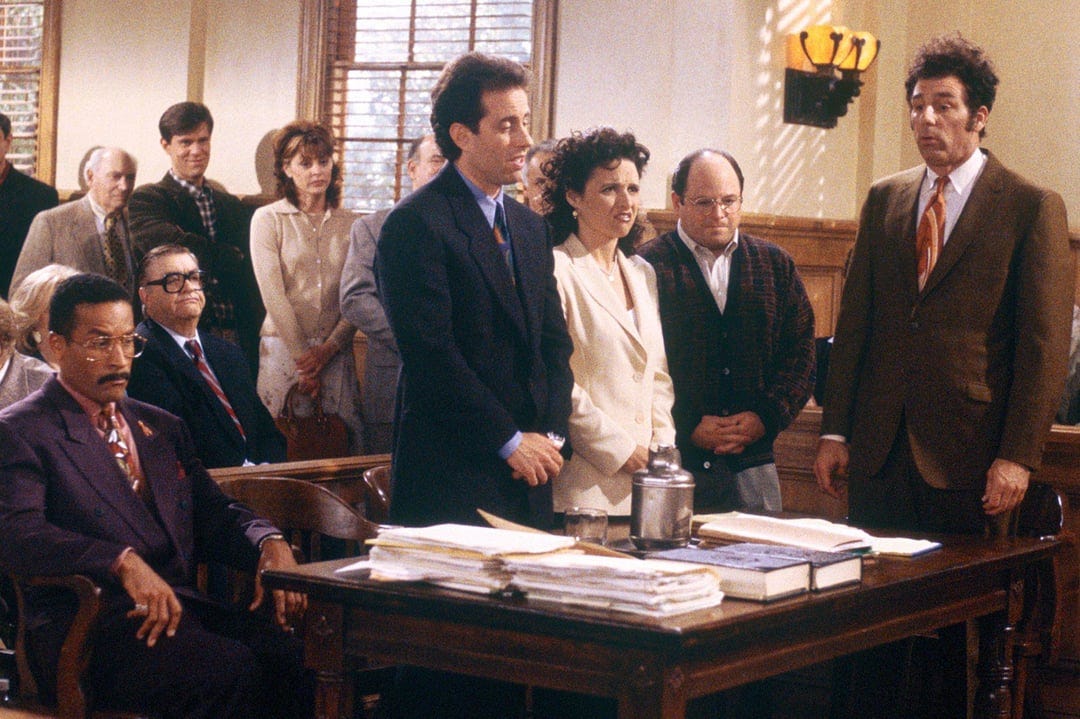
I know Jerry Seinfelds (proverbially speaking), and you probably do too. For them, the possibility of jokes always outweighs the possibility of empathy. I don’t think I’m that sort of person. But laughing at a pre-dodgeball eulogy sounds very much like a Seinfeld plot. Is there a principled difference between me and Jerry?
If there is a distinction — and I’m not positive that there is — I think it has something to do with the reparability of the pain at which one is laughing. You don’t always have to pretend the pain isn’t there. You can do something to make it go away. Jerry chooses to riff on the ongoing robbery rather than calling the police. We (and the showrunners) condemn his reaction because he could have done something about it, but decided to laugh instead.
When the damage is already done, however, humor can stave off the cynicism that would otherwise result from trying and failing to find a way to fix the unfixable. The Holocaust looms still over each of my family holidays. It is an irreparable pain for my grandparents. But I do not have a time machine, and neither do they. So they laugh at the Shoah. Meanwhile, I laugh at the dodgeball tournament, because a young man passed away for no reason and apparently, there is nothing I can do about it other than playing a children’s game in his honor. Per Kurt Vonnegut: “Laughter and tears are both responses to frustration and exhaustion. I myself prefer to laugh, since there is less cleaning up to do afterwards.”
In this distinction, humor sounds like surrender. Sometimes, it probably is. And that’s fine. Yet it can also function more like a deep breath, taken to pause and prepare yourself for a job you’re not sure you can do. My friend from the dodgeball tournament is now a therapist for children with OCD, depression, and anxiety. He has suffered through the same conditions, and now he takes action to help others heal. He and his coworkers also tell each other funny stories about their patients, just as ER doctors do about theirs, and just as teachers do about their most difficult students.
Those approaches, I think, form a necessary loop. My friend can help one kid, or a dozen, or a hundred; yet there is always one, a thousand, a hundred thousand more. He is draining the ocean with an eyedropper.
With each saltwater bead, the absurdity of his task grows. He could throw his instrument away and find something else to do. He could swallow the water instead – faster, but eventually nauseating. Or he could kneel down to the waves again, imagine that he’s nearly done, and smile, because he isn’t. Then he can squeeze the dropper, and there is one less tear in the ocean. One must imagine Sisyphus laughing.
Amazing job. Can’t wait for more
Absolutely excellent